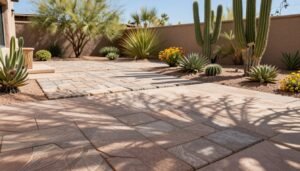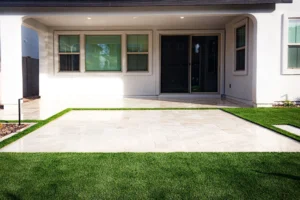
Porcelain and carefully selected natural stone are strong starting points for Arizona’s exposed outdoor kitchens. Each product still needs approval for its intended outdoor use. Sun, heat, dust, and moisture all affect the choice for a desert patio. Sintering is a process that uses heat and pressure to form a dense surface from mineral materials. A good selection balances climate performance with how the counter will be used and maintained.
Key Takeaways
- Start with products approved for the counter’s actual outdoor exposure.
- Porcelain and selected natural stone are strong options for uncovered areas.
- Check the exact product’s care directions, rating, and warranty.
- Plan shade and counter placement around the hours people will use the space.
- Fit the surface to the grill, prep area, and seating plan.
- Confirm utility locations and appliance sizes before construction starts.
Which Outdoor Kitchen Countertops Arizona Homeowners Should Compare?
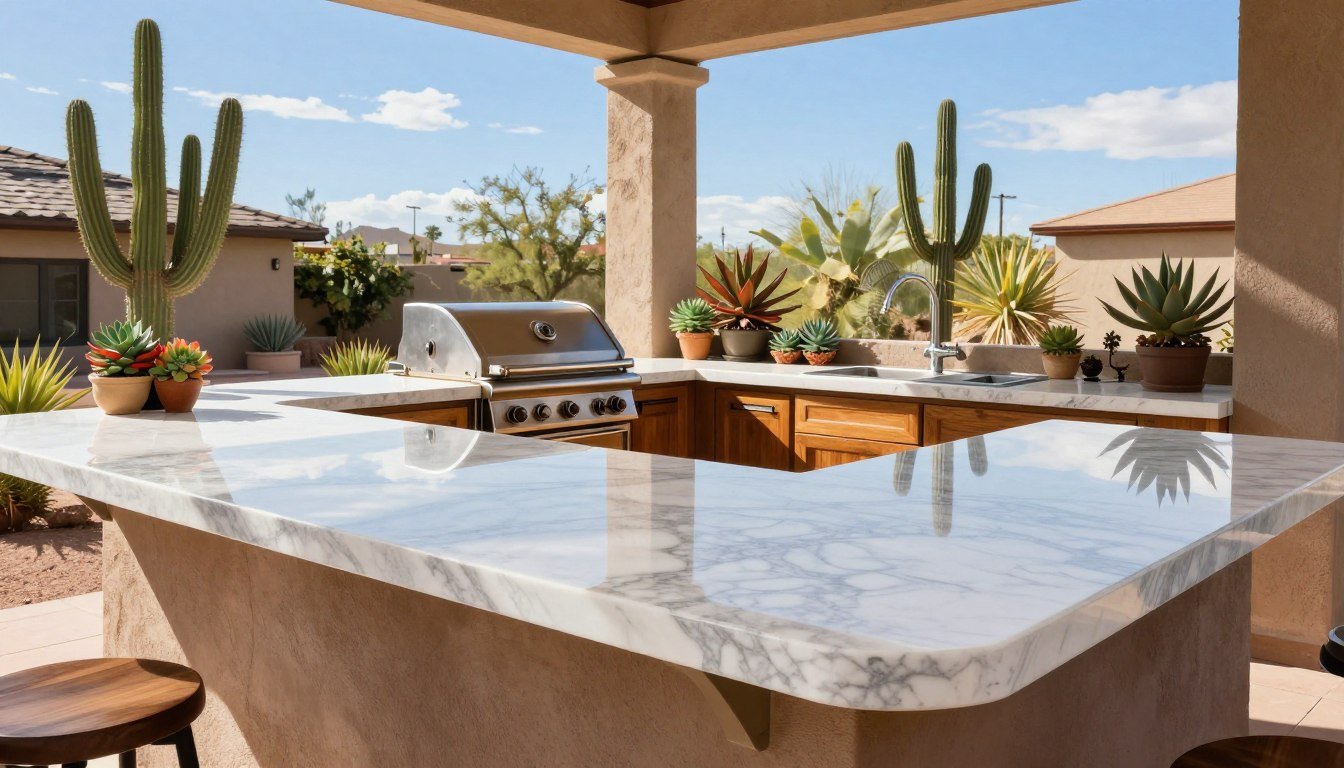
For many uncovered Arizona counters, begin with porcelain and carefully selected natural stone. Then check each product’s outdoor approval. The best outdoor kitchen countertops in Arizona start with outdoor-rated products and checks for the site’s real conditions.
Compare material families, not just sample colors. Granite and quartzite are natural stone choices, while standard engineered quartz contains resin and mineral particles. Sintered stone forms a dense surface through sintering. Product details vary within each family, so one rating cannot speak for every brand or finish.
| Material family | Condition to investigate | First item to verify |
|---|---|---|
| Porcelain tile or slab | Uncovered sun and rain | Written exterior-use approval |
| Granite | Full sun near a grill | Slab-specific exterior suitability |
| Quartzite | Weather exposure and upkeep | Outdoor rating and care directions |
| Standard engineered quartz | Covered patio with limited sun | Explicit outdoor approval |
| Sintered stone | Uncovered use and daily wear | Exact product rating and warranty |
These are five useful material families to compare before you settle on a countertop material. A covered patio can have different exposure from a counter beside a pool or grill. Ask whether the product’s written specifications cover the full setting, including sun, moisture, and temperature changes.
Keep the shortlisted options to products whose written specifications match the counter’s actual exposure.
Why Does Porcelain Work Well in Arizona Sun?
Porcelain earns a place on an exposed counter shortlist because its UV stability, heat resistance, and low porosity suit several desert conditions at once. It can work for an outdoor kitchen or poolside counter when the exact product is approved for that setting.
Porcelain tile that meets ANSI A137.1 has water absorption of 0.5% or less. That low rate helps explain why porcelain is often considered for exterior use. It does not replace the need to check the manufacturer’s use rating or installation directions.
Porcelain slab surfaces in exposed areas
A large-format slab can create a broad counter surface with fewer visible joints than a tiled top. That can make wiping crumbs and dust from a serving area easier. Confirm that the slab, edge detail, and finish all carry suitable outdoor approval.
Slabs still need a sound base and careful support around cutouts. Grill openings, corners, and overhangs place different demands on the surface. A sample that looks smooth indoors cannot show how the full installed counter will perform.
Porcelain tile, grout and outdoor detailing
A tile countertop has grout joints, unlike a single slab surface. Those joints need an outdoor-rated grout and a skilled installation. The exterior tile installation guidance discusses standards, movement joints, and weather exposure.
Freezing and thawing can stress grout and tile assemblies where those conditions occur. Arizona’s climate does not remove the need to plan for local temperature swings. Ask the installer to specify an outdoor-suitable tile assembly and grout, not just an attractive tile.
Should You Choose Granite, Quartzite, or Soapstone?
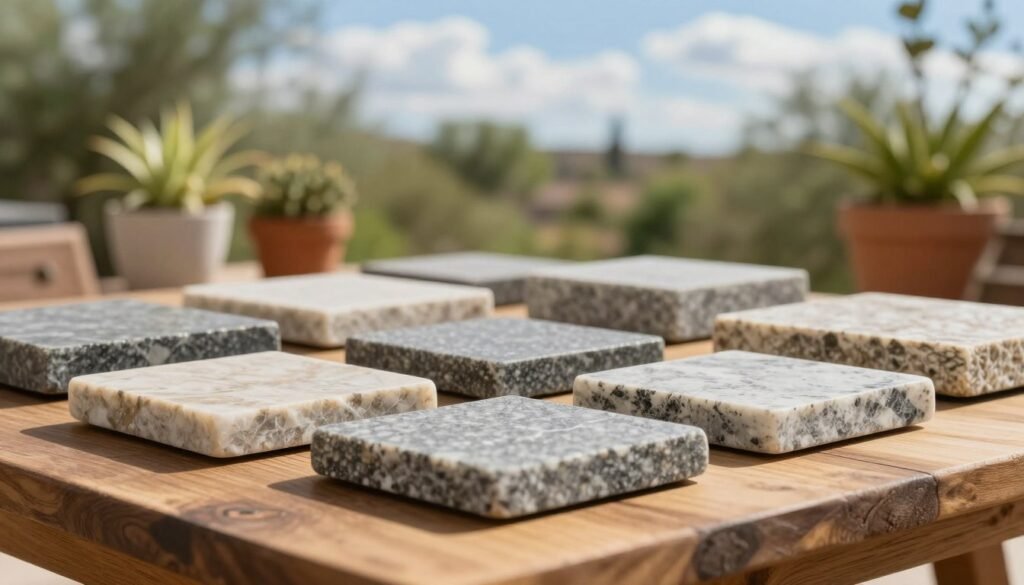
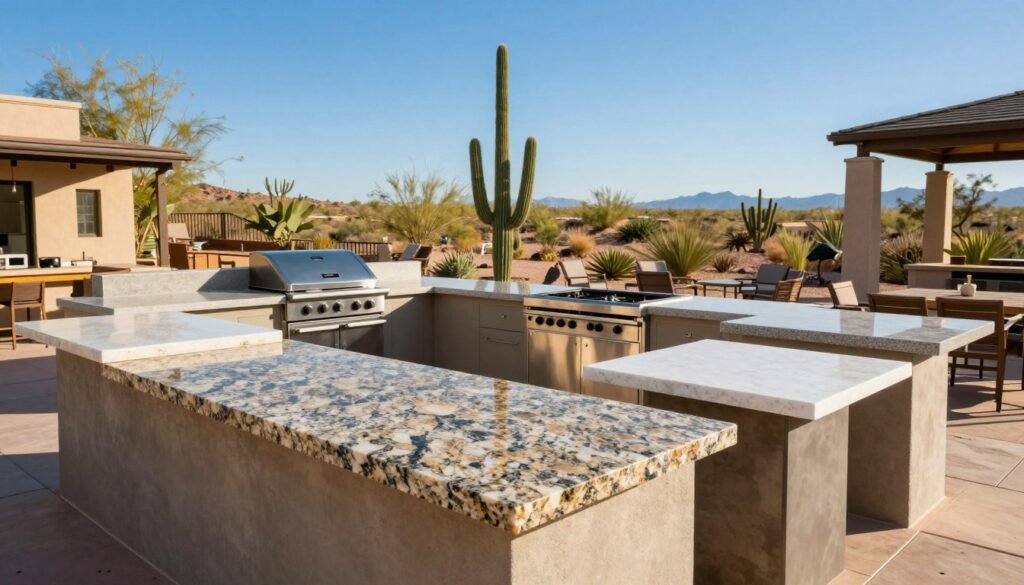
Granite is a familiar outdoor choice, while quartzite and soapstone give homeowners other natural-stone looks to investigate. Granite and quartzite resist UV and heat, but each slab still needs a product-specific review for outdoor use.
Stone can bring natural color and pattern into a kitchen, though each slab varies. That variation is part of the appeal, but it also makes slab selection important. Check the actual piece rather than relying only on a small showroom sample.
Granite for grill and prep zones
Granite is valued for resisting heat, scratches, and stains, which suits busy cooking and prep areas. Its strength does not make every slab suitable for full sun. Ask about the chosen slab’s exterior rating and how its finish responds to weather.
Granite commonly needs periodic sealing. One maintenance guide describes resistance to heat, scratches, and stains with proper sealing. The exact care plan depends on the stone and its product instructions. A grill-side counter also faces grease, food spills, and frequent wiping.
Quartzite and soapstone for natural variation
Quartzite offers another natural pattern and can resist UV and heat. It also needs sealing, so include that upkeep in your choice. Do not assume that a stone labeled quartzite has the same finish or care needs as another slab.
Soapstone has a distinct, often softer-looking character. It stands up to sunlight and moisture, and expands and contracts less readily than some stones during cold-weather cycles. That trait may matter more in colder climates than in much of Arizona. Confirm the individual slab’s exterior suitability before selecting it by color or pattern.
Can Engineered Quartz or Sintered Stone Handle Outdoor Use?
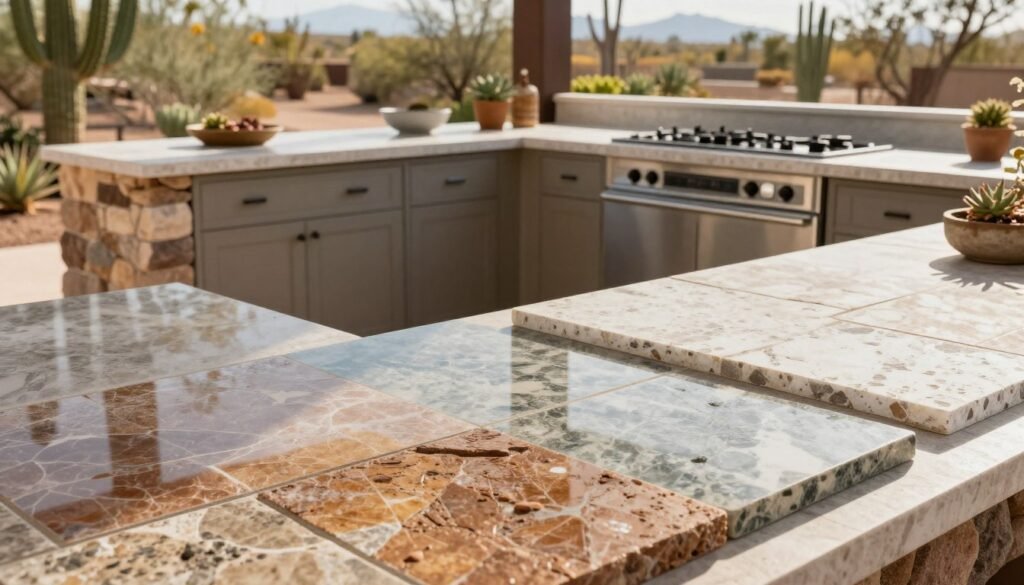
Standard engineered quartz is a poor default for constant direct Arizona sun because its resin binder can yellow or fade. A covered setting does not by itself make every product suitable for outdoor use.
Engineered quartz combines resin with mineral particles, while sintered stone is formed from mineral materials under heat and pressure. These are different surface types, and the name of a material family does not establish an outdoor rating. Check the exact product’s written approval and warranty.
Standard engineered quartz in direct Arizona sun
Resin binders can change with ongoing exposure to direct sunlight, which can lead to yellowing or fading. Standard engineered quartz is therefore not a safe default for uncovered counters. If considering it on a covered patio, confirm that the specific product has explicit outdoor approval.
Some makers sell separate outdoor lines. Caesarstone’s Outdoor Collection surfaces are UV-resistant and were tested for weather and UV resistance. That claim applies to the named collection, not to every engineered quartz product or every countertop with a similar look.
Sintered and ultra-compact surfaces
Viana Sintered Stone is outdoor-rated and has a UV Stable Class A+ rating. Its stated heat resistance is 300°C, water absorption is below 0.02%, and it requires no sealing. These values apply to Viana Sintered Stone, not all sintered surfaces.
Viana lists a Mohs hardness of 8 and says its product contains 100% natural minerals, with no resins, plastics, or VOCs. Its residential warranty is 15 years. Check the warranty terms for the exact application, since coverage can depend on product and use.
Dekton and Neolith are ultra-compact surface examples. Their outdoor materials are described as resistant to scratches, stains, extreme temperatures, and UV light. Treat each brand’s product specifications as product-specific, not as a promise for every finish. Check the product’s outdoor rating, care instructions, and warranty for the exact surface being considered.
How Do Sun, Shade, and Color Affect Countertop Comfort?
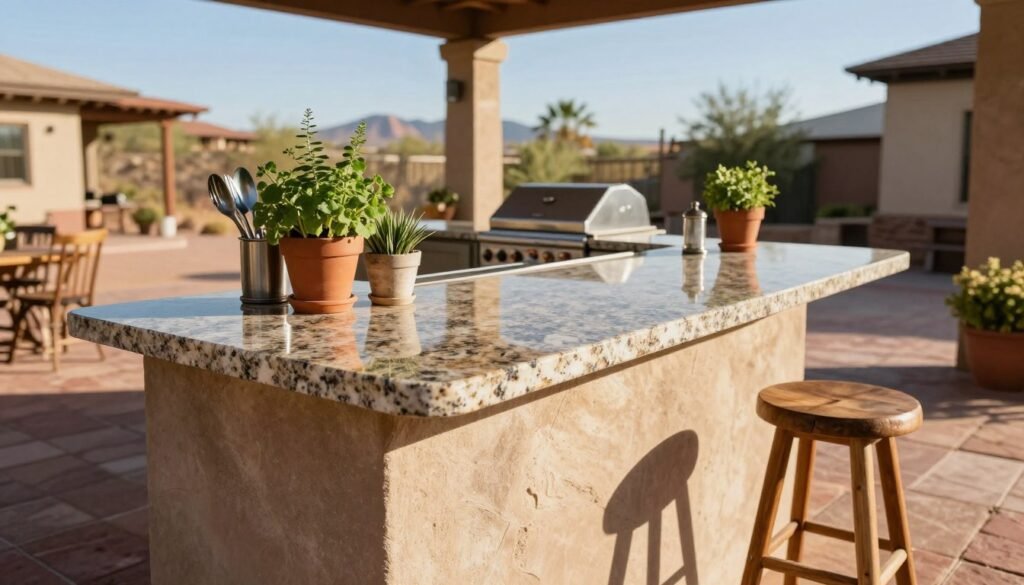
A surface can withstand summer exposure and still be uncomfortable to touch during direct sun. Outdoor countertops in Arizona can grow hot enough to affect cooking, serving, and casual use, even when the material is rated for outdoor use.
Shade is a practical way to make a patio kitchen more comfortable. A roof, pergola, or other shade feature can change how the counter feels during use, though results depend on the site and design. Dust and moisture still reach uncovered counters in Phoenix and Scottsdale.
Assess the uncovered zone for direct UV, temperature changes, moisture, and dust. A dark or light color may also affect the look and feel of a surface, but color alone cannot predict comfort. Consider how the sun moves across the cooking and serving areas.
- Hours of direct sun on the counter
- Shade over cooking and serving areas
- Dust and rain exposure
- Where people will stand or sit
For a kitchen design, the placement of shade matters as much as its presence. A small shaded prep area may not protect the serving bar or the place where guests gather. The outdoor kitchen planning ideas address how sun, seating, and patio use can shape placement.
Check shade at the hours the kitchen will actually be used, not only at the time of a site visit.
What Maintenance Do Arizona Outdoor Countertops Need?
Outdoor countertop upkeep is easier to plan when the owner knows which surfaces need sealing and which joints need inspection. Natural stone, tile, and the surrounding counter area each call for different checks.
Start with the care directions for the specific surface. A cleaner or sealer made for one stone can harm another finish. Dust, food residue, and moisture also call for regular cleaning suited to the product.
Sealing and cleaning natural stone
Granite is commonly resealed about once a year, but the right schedule depends on the selected stone and its care instructions. Sealer needs can vary by finish and use. Follow the product directions rather than setting a schedule from the stone name alone.
Wipe spills with a cleaner approved for the surface, especially around a grill and prep area. Avoid applying a new sealer over residue or an incompatible cleaner. If the maker lists a test for sealer needs, follow its method.
Inspecting tile grout and joints
Check grout joints for cracks, gaps, or areas that hold grime. Small flaws can collect water and food debris, so clean joints with products approved for that grout. Tile installation details matter outdoors, including movement joints where the assembly calls for them.
A slight drainage slope helps water move away instead of standing on the counter. A general outdoor-surface slope is 1/8 inch per foot. That pitch can also limit deposits of dust and grit when water dries. Follow the surface maker’s care instructions before choosing a sealer or cleaner.
How Should the Countertop Fit Your Kitchen Layout?
Start the layout with the grill and the people who will use the counter, then fit the surface around them. A typical kitchen counter stands about 36 inches high, while a bar is about 42 inches high.
Outdoor grills range from under 30 inches to over 48 inches wide. That range affects counter runs, nearby prep space, and the fit of doors or drawers. Plan around the actual appliances rather than a typical size alone.
| Zone | Main activity | Typical height or fit consideration | Coordination check |
|---|---|---|---|
| Grill station | Cooking | Grills range under 30 to over 48 inches | Clearance and cutout size |
| Prep counter | Chopping and staging | About 36 inches high | Work surface beside grill |
| Serving bar | Eating and serving | About 42 inches high | Seat height and knee room |
| Poolside serving area | Setting down food and drinks | Fit the path and seating | Traffic between pool and kitchen |
A grill, access doors, drawers, and seats all use part of the available run length. The counter also needs enough usable room for the intended tasks. An outdoor kitchen design should let people move between cooking and serving without crossing each other’s work space.
- Appliance sequence
- Number of seats
- Access between the cooking and serving sides
Confirm appliance cutouts and seating dimensions against the final plan before ordering a slab.
What Should Countertop Installation Include?
A durable installation begins with a coordinated site plan, because service lines and the counter structure have to fit the same layout. Gas piping, electrical conduit, and any water or drain lines are commonly planned before concrete is poured.
Arizona sites may include caliche, a hard soil layer that can affect excavation. Protect low-water landscaping and irrigation during the work. Where a lawn is present, coordinate the project with seasonal turf care.
Plan the island, utilities and foundation
Decide where appliances, service lines, and the island will sit before the footing work begins. A masonry footer can use 1/2-inch rebar before concrete placement. The footing and base must support the planned counter and appliance openings.
Have the contractor check the layout against appliance dimensions and utility connections during the build. A gas line or conduit placed without checking the grill cutout can conflict with the finished plan. Site access, irrigation, and nearby paths also need to stay clear.
- Confirm the layout and appliance dimensions.
- Locate planned gas, electrical, and plumbing runs.
- Excavate and build the reinforced footing and masonry base.
- Set the counter after masonry construction.
- Complete finishes and connect the appliances.
Set the counter and complete the finish work
Countertop installation follows masonry construction. The installer should check support, fit, and openings before setting the surface. Edge details and seams should match the product directions and the kitchen plan.
After setting the counter, finish the surrounding joints and connect appliances. Keep the work area clear of landscape irrigation and protect nearby planting. Coordinate any turf work with the season if the kitchen sits beside a lawn.
Have the final appliance dimensions and utility locations confirmed before the footing and masonry work begin.
Conclusion
Choose for the conditions at the counter, not just the look of a sample indoors. The best choice matches the exact product rating with the counter’s real exposure, daily use, and care needs.
A thoughtful design also leaves enough room for cooking, serving, and moving through the patio. Decide what the kitchen needs to do before committing to a surface or final layout.
Visit rtloaz.com to discuss your outdoor kitchen project with RTL Outdoor Services.