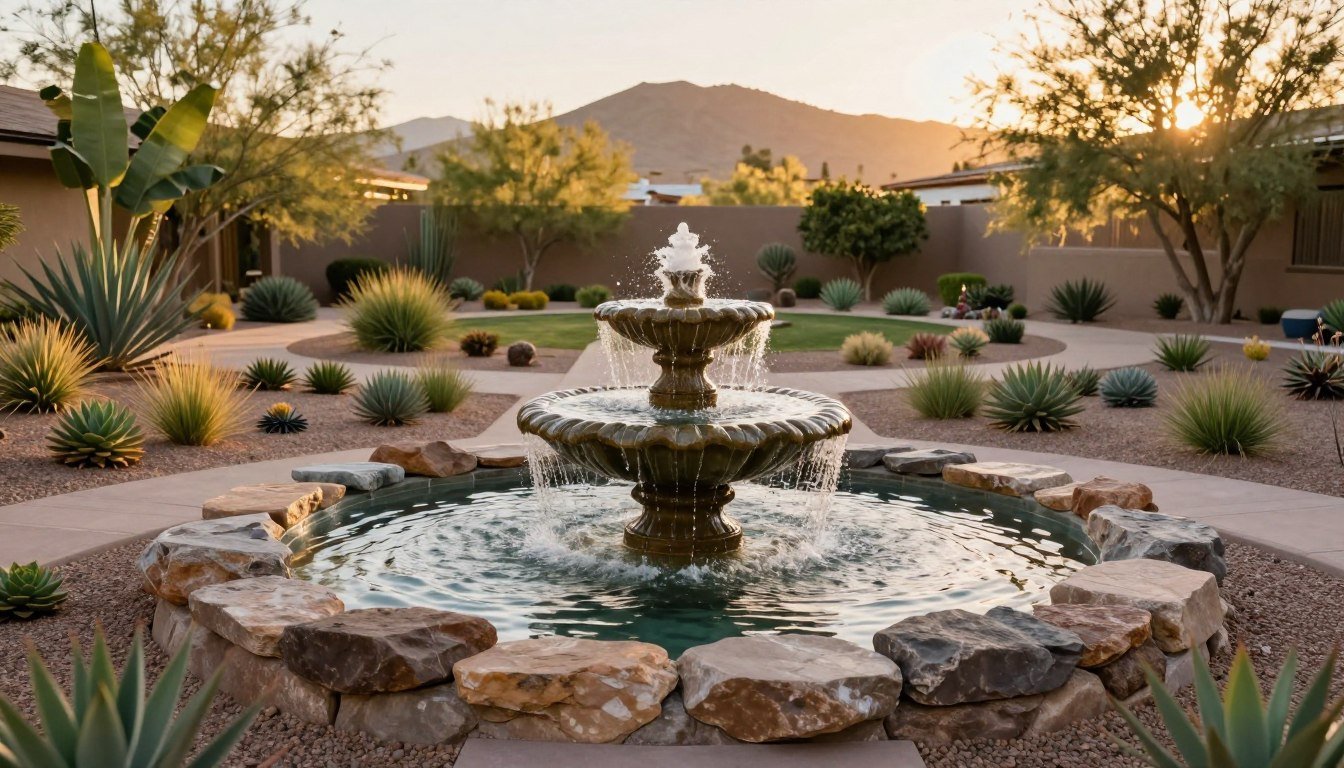
Garden water feature cost Scottsdale homeowners face is shaped mostly by scale, materials, pump and reservoir engineering, and site access. A compact pre-built fountain and a custom estate feature occupy very different budgets, so compare the completed installation scope and operating needs rather than the fixture alone.
Arizona’s desert climate makes placement and water planning important, even in a low-water landscape. Caliche soil can affect excavation, while seasonal turf care may shape when crews can dig.
Sound and views from your home can guide placement, along with the backyard’s sun exposure. Options range from a freestanding fountain to a stream or a waterfall among stone and plants.
A pondless reservoir is an underground basin that collects and recirculates water from a fountain or waterfall without an exposed pond. A feature that suits the yard’s layout and the household’s upkeep preferences is more useful than one chosen for appearance alone.
Key Takeaways
- Scale, materials, pump design, and site access shape installed cost.
- Luxury installations fall into three broad budget tiers.
- Small pre-built fountains need less work than custom watercourses.
- Summer evaporation makes exposed surface area an important choice.
- Plan utilities, drainage, and permits before excavation begins.
- Compare written scopes, not just the contractor’s headline price.
Garden Water Feature Cost Scottsdale: What Should Homeowners Budget?
Scottsdale’s 2026 luxury installations span three tiers, from $8,500-$28,000 for Tier 1 to $95,000-$325,000+ for Tier 3. Tier 2 installations range from $28,000-$95,000.
These figures cover luxury water features, not every residential fountain. A small off-the-shelf fountain is a different project from a custom water feature built into a larger landscape.
Tier 1 usually covers a focused luxury installation with a defined feature and supporting work. Tier 2 often brings a broader design, more complex equipment, or added landscape integration. Tier 3 serves estate-scale projects with extensive design and construction needs.
Most Tier 1 projects cost $14,500-$19,500, while most Tier 2 projects cost $48,000-$72,000. Full estate-class commissions in Tier 3 regularly exceed $185,000.
| Tier | Installed range | Most-project range or signal | Typical scope |
|---|---|---|---|
| Tier 1 | $8,500-$28,000 | $14,500-$19,500 | Focused luxury feature |
| Tier 2 | $28,000-$95,000 | $48,000-$72,000 | Broader custom design |
| Tier 3 | $95,000-$325,000+ | Commissions regularly exceed $185,000 | Estate-scale work |
Compare proposals by the work and equipment included, not by the tier label alone.
Which Design Choices Raise the Installation Cost?
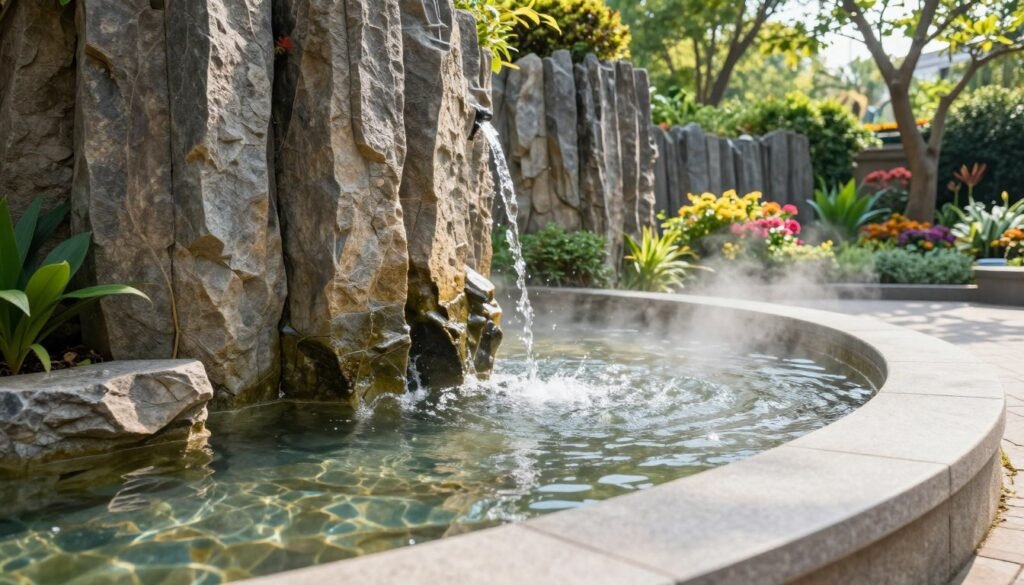
A project’s biggest specification changes are often the pump setup, reservoir housing, finish materials and landscape work around the feature. Each choice affects labor, access, and how the feature fits the yard.
Pumps, Pump Vaults and Smart Controls
A single pump keeps the setup simpler, while Tier 2 dual-pump configurations add $1,500-$3,200 for redundancy. A Tier 2 pump package costs $1,850-$4,500.
A dedicated pump vault houses and protects the pump, with a small vault adding $3,500-$8,500 in Scottsdale in 2026. A correctly matched pump can support reliable flow and efficient operation.
The U.S. Department of Energy’s Pump Systems Matter overview notes that system optimization can yield energy savings of 20%-40% or more. That broad figure is not a home-specific savings estimate.
For water features above the $25,000 installation threshold, smart-home integration adds $2,800-$12,500, plus $1,500-$4,500 for initial programming. Controls can link pump and lighting functions with a home system.
Stone, Reservoirs and Landscape Work
Tier 2 custom basalt columns cost $850-$2,800 per column. Mexican beach pebble or polished river rock costs $6.50-$18 per square foot installed.
Custom flagstone or travertine spillway work costs $42-$95 per square foot. Naturalized boulder placement costs $1,200-$4,800 per boulder, including crane time and grading.
Arizona landscaping in 2026 typically costs $4.50-$17.00 per square foot, with an average near $9.00. Phoenix and Scottsdale landscape design services cost $86-$100 per hour, so nearby yard work may sit outside the feature price.
One costly mistake is choosing decorative stone before confirming the flow path, equipment access, and water exposure. Ask for the quote to separate feature construction from adjacent landscape work so each cost can be compared on its own.
How Much Water Does a Scottsdale Feature Use?
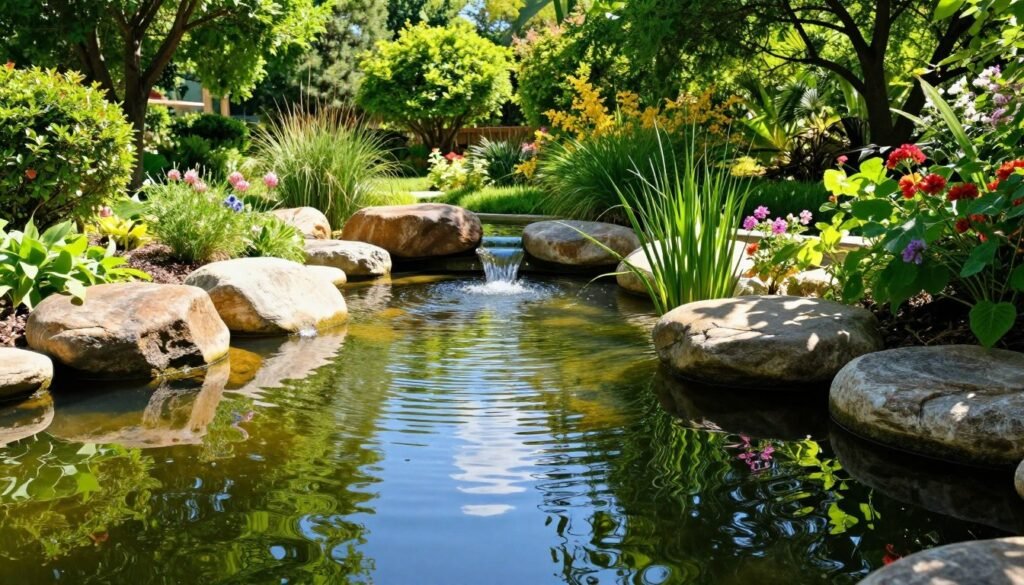
A 350-gallon reservoir with 25 square feet of exposed surface area can lose 60-95 gallons per week during peak Phoenix-area summer. Open water can evaporate one-third to one-half inch per day from June through August.
Summer Water Loss
A pondless feature recirculates water from an underground reservoir and usually exposes less water than a traditional pond. Less exposed surface can mean less evaporation, though wind and heat still affect water levels.
Reservoir surface area matters because evaporation rises with the exposed area. Autofill can replace lost water, while overflow protection limits excess filling and a low-water cutoff helps protect the pump.
In Scottsdale in 2026, adding a 350-750-gallon Tier 2 reservoir with autofill, overflow protection, and a low-water cutoff costs $3,500-$8,500 above the base feature build. These controls help manage water level but do not prevent evaporation.
Scottsdale Water Rates
Scottsdale’s proposed FY 2026/27 residential commodity rates take effect November 1, 2026. The proposed monthly base water fee for a 5/8-inch meter is $16.46, billed separately from commodity use.
| Monthly usage block | Proposed commodity rate per 1,000 gallons |
|---|---|
| First 5,000 gallons | $1.80 |
| 5,001-12,000 gallons | $3.39 |
| 12,001-20,000 gallons | $4.96 |
| 20,001-30,000 gallons | $6.55 |
| More than 30,000 gallons | $8.41 |
At 1,000 gallons, the first-block commodity charge is $1.80. A 10,000-gallon month crosses the first two blocks, with rates of $1.80 and $3.39 per 1,000 gallons; no combined bill is shown here.
A smaller exposed surface area can reduce evaporation, but it does not remove the need to monitor water level and refill protection.
What Does It Cost to Run and Maintain a Feature?
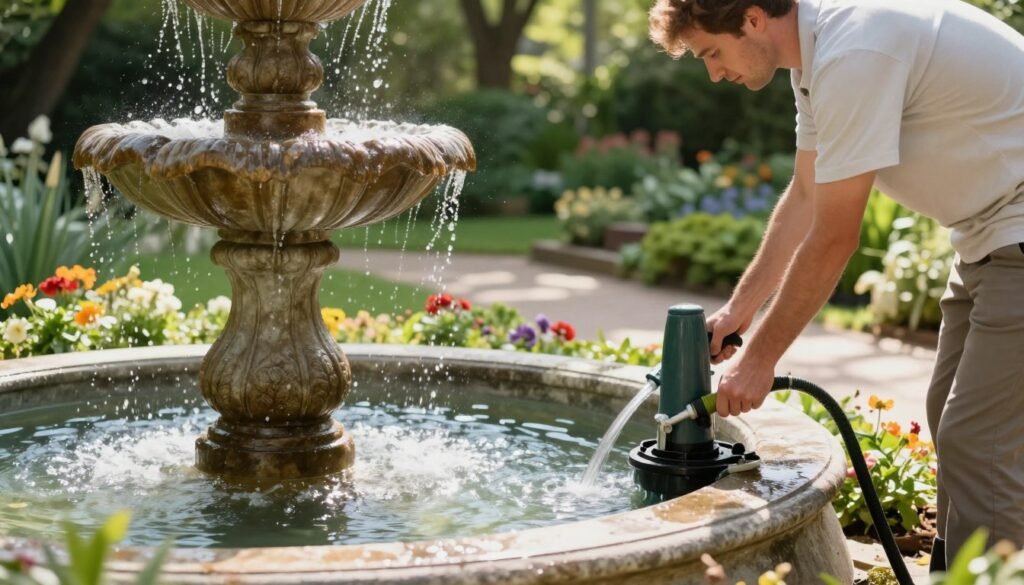
Pump electricity cost is determined by the pump’s wattage, hours of operation and the rate charged for each kilowatt-hour. Continuous operation uses more power than a shorter daily schedule.
Electricity for Pumps
Arizona’s average residential electricity rate was 15.59 cents per kilowatt-hour in January 2026. A pump’s actual bill depends on its rated power, runtime, and your rate.
A 200-watt waterfall pump running around the clock costs about $25.92 monthly at the 2026 national average rate of 18.02 cents per kilowatt-hour. A 50-watt fountain pump running continuously costs about $61.32 yearly at $0.14 per kilowatt-hour.
Those examples use different rates and time periods, so they are not direct comparisons. Check the pump label and your utility rate to estimate your own water feature’s power use.
Cleaning, Repairs and Service
In Phoenix metro in 2026, standard residential fountain pump replacement costs $300-$800 installed. Outdoor fountain repair calls typically cost $200-$700.
Residential fountain maintenance starts at $80 per visit. Larger custom or multi-feature plans start at $120 per visit, while deep cleaning a small or mid-size fountain costs $250-$400.
Sun, wind, dust, and mineral buildup can change how often a fountain needs attention. Use this maintenance checklist to spot common problems:
- Keep the water level adequate.
- Remove leaves and debris.
- Clean the pump and intake.
- Inspect water flow for leaks or obstructions.
Check the pump’s water supply before restarting it after cleaning, since running dry can damage the equipment.
Which Fountain Design Fits a Small or Mid-Size Yard?
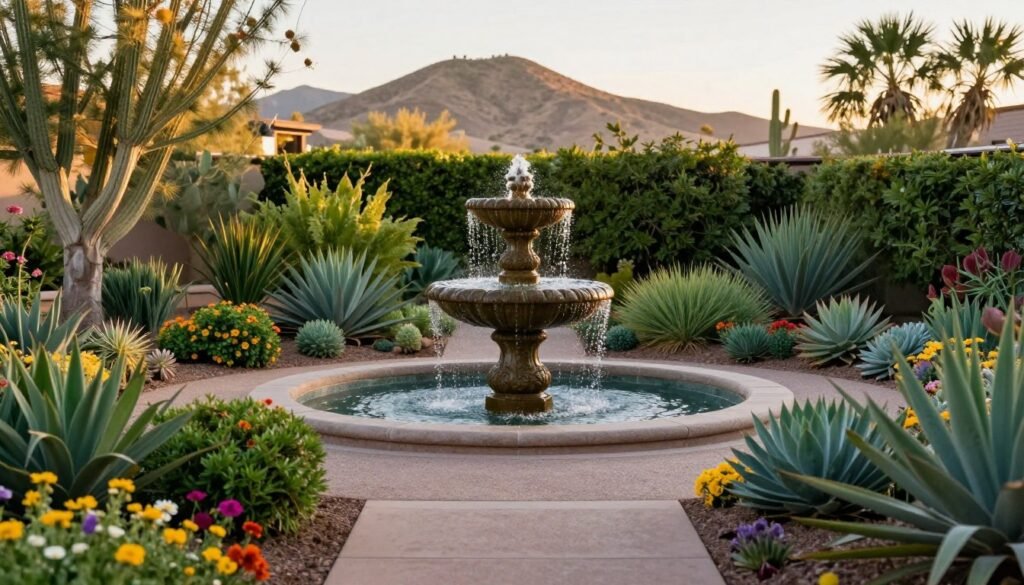
A small pre-built fountain is the lower-scope option, while a heavier tiered fountain or a custom watercourse brings more site and access work. The right design should fit the available garden space and the sound you want outdoors.
Small Garden Water Feature Costs
A small pre-built residential fountain installation costs $1,400-$2,500 in Phoenix metro in 2026. That scope includes site preparation, recirculation plumbing, and a new GFCI-protected outlet.
Compact fountains can suit courtyards where a large pool or stream would crowd the seating area. For more ideas, see these small Scottsdale backyard design ideas.
Mid-Size Fountains and Pondless Falls
A mid-size cantera or concrete tiered fountain installation costs $2,500-$5,000, depending on size, weight, and access. New outdoor fountain installation costs $1,400-$5,000+ across Phoenix metro in 2026, based on size and complexity.
That broad fountain range does not price a luxury custom build. Ponds and water gardens create open-water views, while ornamental and reflecting pools offer a calmer surface.
Streams and waterfalls add moving water and sound, while freestanding fountains can work as compact focal points. Pondless designs send water back to an underground reservoir instead of an exposed pond.
Consider how the feature will look from doors, windows, and seating areas. Match the feature’s scale to the courtyard or yard so the focal point does not overwhelm the space.
What Should Installation Include in Scottsdale?
A successful installation starts with a site plan that accounts for access, utilities, sun, wind and the surrounding landscape. Good planning helps crews place the feature without disrupting drainage or nearby planting.
Plan the Site and Utility Routes
Check the view from inside your home, then note sun and wind exposure across the yard. Plan equipment access, power, drainage, and a clear route to the pump.
Desert heat and low-water planting can shape the landscape design around the feature. Caliche soil may affect excavation, and seasonal turf care can affect digging or irrigation work near grass.
Before work begins, map the route for power, plumbing, and drainage. Confirm that the feature and reservoir fit without blocking access to other yard equipment.
Check Permits Before Excavation
A freestanding fountain plugged into a GFCI outlet usually needs no city permit in Arizona. Hardwired pumps, underwater lighting, and automatic fill lines commonly require electrical or plumbing permits.
Arizona cities often require permits for ponds deeper than roughly 18-24 inches, but each city sets its own depth threshold. Local rules vary, so confirm current requirements before work starts.
Use this order to organize the project:
- Choose the location.
- Identify utility and drainage routes.
- Confirm the feature and reservoir footprint.
- Check applicable permits.
- Coordinate excavation and installation.
Confirm permit requirements with the relevant local authority before excavation or electrical and plumbing work.
How Can You Compare Scottsdale Water Feature Contractors?
Compare contractors by written scope, relevant project experience and verifiable licensing, not by the headline price alone. Two proposals are comparable only when they describe similar work.
Use this four-point proposal checklist before committing to a project:
- Verify the Arizona license and relevant classification.
- Request a written scope separating equipment, materials, electrical, and plumbing work.
- Ask for examples of comparable completed projects.
- Confirm warranty coverage, exclusions, cleanup, and payment terms.
The City of Scottsdale manages residential permit submissions and inspections through its permitting system. Use the Arizona Registrar of Contractors license lookup before signing a contract.
Conclusion
A thoughtfully scaled feature can bring sound and movement to a Scottsdale yard while keeping its upkeep aligned with the homeowner’s needs. The best custom water feature also fits the site, from soil and utility routes to the yard’s daily use.
RTL Outdoor Services can help shape a plan for Scottsdale water features that suits your property and outdoor environment. Visit rtloaz.com to request a tailored estimate for your property.