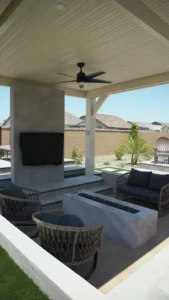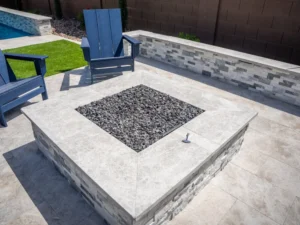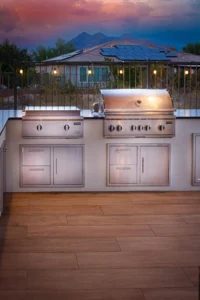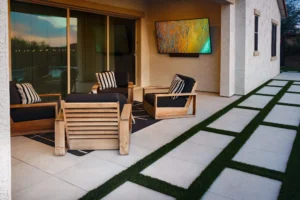
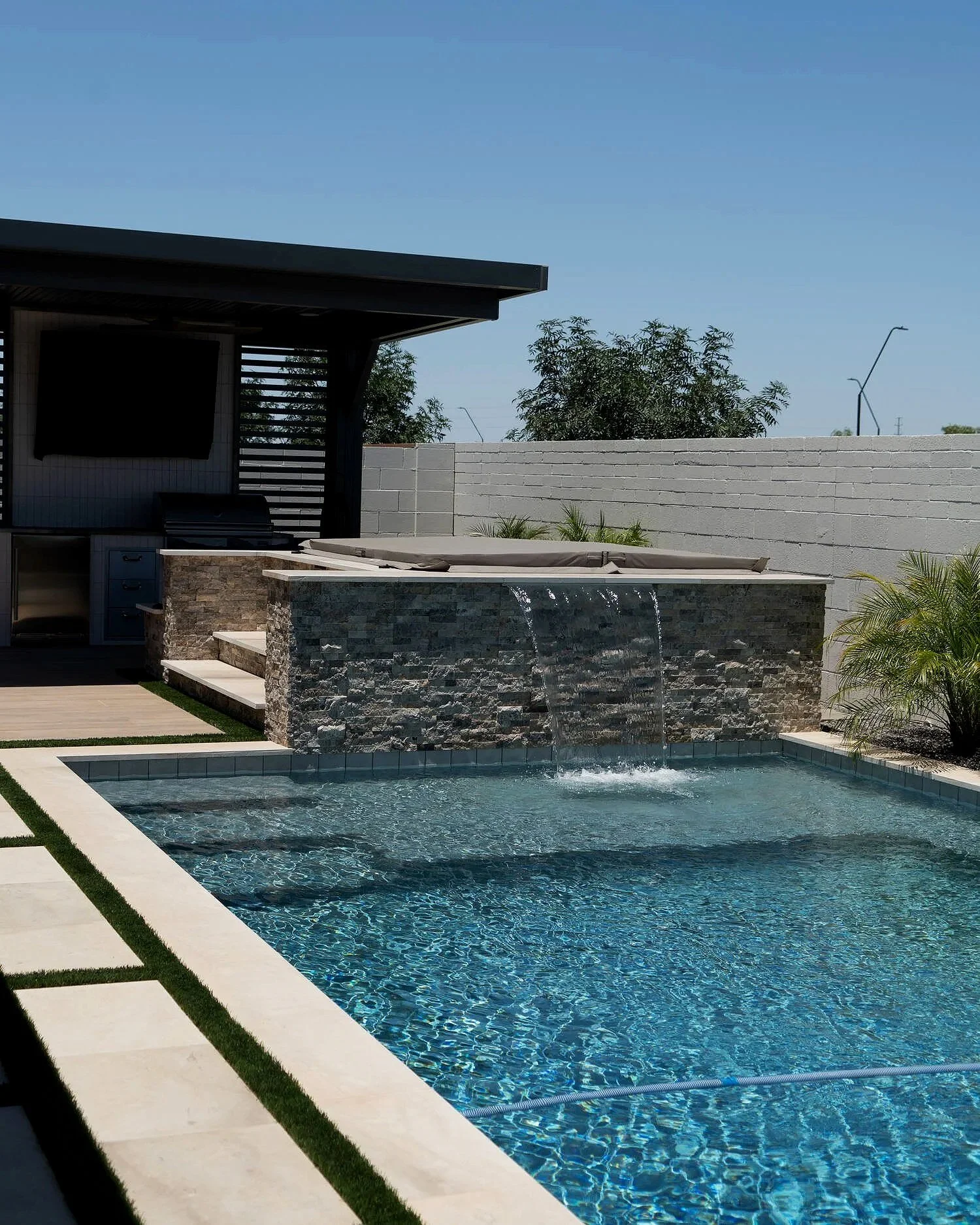
Among the water features Scottsdale AZ backyards can hold, a pondless waterfall gives the most sound for the least open water. A sheer descent suits a modern patio or pool edge, and a fire-and-water combination works only where the seating area has room for open clearance.
A sheer descent is a spillway that releases a smooth sheet of water over the edge of a wall. A pondless waterfall, by contrast, runs its water through a buried basin with no open pond. If your yard is still gravel, rock or bare dirt, this backyard renovation starts with shade, sound and a focal point.
Scottsdale’s intense sun, wind and evaporation change how any feature performs, so the yard’s exposure matters from the start. This article takes the decisions in the order you will face them: style, pump and basin size, permits, fire safety, desert rules, upkeep and choosing an installer. Start with the style, since it sets every choice after it.
Key Takeaways
- Yard space and sun exposure decide which style fits best.
- A pondless waterfall suits most backyards with room for a stream.
- A sheer descent fits a modern patio or pool edge.
- A fire-and-water combination needs open room around the seating.
- Choose the style first, then work through the rest in order.
Water Features Scottsdale AZ Styles Compared
A pondless waterfall suits most Scottsdale backyards with room for a stream, while a sheer descent fits a contemporary patio or pool edge. The best water feature for most yards is the pondless waterfall, since it makes a steady sound with no open pond to clean. Best water features in Scottsdale AZ depend on the space, but a stream wins in most larger backyards.
Outdoor water features in Scottsdale AZ are chosen by the space and the sun more than by the look alone. Each style has one main design constraint that you should check before you choose it.
| Style | Best fit in Scottsdale yards | Main design constraint |
|---|---|---|
| Pondless waterfall | A backyard with room for a stream | Its buried basin must be sized to the stream |
| Sheer descent | Contemporary patios and pool edges | A thin sheet is more exposed to wind and evaporation |
| Fire-and-water combination | A seating area with room for a fire element | Open clearance must stay around the fire |
| Wall or column fountain | A compact courtyard | Needs a level base and a power outlet |
A column feature needs only a level base, a nearby power outlet and a small section of wall or patio. That makes it the right pick for a courtyard that cannot take a stream. Outdoor water fountains near you are often freestanding, so they suit a patio with no space for a buried basin.
A scupper bowl gives a visible, controlled stream, which works well in a courtyard. Sun exposure changes how a sheer descent holds up, since wind and heat pull water off a thin sheet quickly. Most designs in Scottsdale should start with the yard’s space and then the sun. Choose the style first, because the pump and basin sizing depends on whether the feature is a waterfall, a sheer sheet or a freestanding fountain.
Sizing Pump Flow and Basin Volume for a Pondless Waterfall
Multiply the stream width in inches by 125 to get the pump flow in gallons per hour. The pump is sized by the width of the stream, not by the size of the basin below it. Once the flow is known, the basin is sized from the stream volume.
The stream volume is the water held in the flowing channel when the stream runs full. The basin must hold about double that amount.
Pump Flow for Waterfall Width
A 2-foot stream is 24 inches wide, so 24 times 125 gives 3,000 gallons per hour. That is the flow the pump must deliver to keep the stream full from edge to edge. Many owners make the mistake of choosing a bigger pump because the basin looks large.
Basin Volume and Head Height
Head height is the vertical distance the pump must lift water, including pipe and fitting allowances. Start with the static head in feet, then add 1 foot for every 10 feet of pipe and 1 foot for each fitting. For a 20-foot pipe run with 2 fittings, add 2 feet for the pipe and 2 feet for the fittings.
Size the basin to hold double the stream volume so the pump stays fully submerged while the stream runs full. A pump rated for 3,000 gallons per hour can still fail if its rated head is too low for your height. Compare the pump’s rated head at the calculated height, not only its flow rating, before ordering.
Scottsdale Permits, Fees and Inspection Deadlines
Scottsdale requires a permit for electrical wiring and for plumbing or gas work on a water feature, and work done without one is fined double the permit fee. An electrical permit covers wiring for lights or a pump. Some smaller home-improvement projects may not need a permit, so the city’s Home Improvement Project Guidance, last updated September 10, 2026, sets the rules for each project type.
Work That Needs a Permit
Check each part of the feature against the permit rules, since one wired light can bring the whole project under permit. A plumbing permit is required to install, alter, reconstruct or repair a plumbing system or gas system. The common triggers are below.
- Electrical wiring for lights or a pump
- Plumbing for the water supply
- Gas lines for a fire element
- Work on a swimming pool or mechanical equipment
A common mistake is assuming a small fountain never needs a permit. A small fountain with wired lights or a plumbed supply can still need one.
Filing Through SPUR and Meeting the Inspection Deadline
File the request through the SPUR portal before work begins. The Permit Services office is at 7447 E. Indian School Road, Scottsdale, AZ 85251.
Book the first inspection within 180 days after the permit is issued, or the permit expires. Schedule the first inspection before the crew buries any lines, so a failed trench does not hold up the job.
Fire Features Next to Water: Clearance and Safety
A fire feature needs 4 feet of clear space on every side and 6 feet overhead before you place any water feature beside it. These distances keep people and combustible items away from the flame. Combustible items include wooden fences, cushions and dry plants.
Check the combustible clearance before you set the fire pit, and mark the 4-foot ring on the ground first. A patio shade structure lower than 6 feet rules out a fire element beneath it, because the overhead clearance cannot be met. In a courtyard open to the sky, the overhead rule is simpler to meet.
Place a GFCI outlet within reach of the pump, since it cuts power quickly when a fault occurs. That outlet lowers the risk of electric shock for the pump and any lights. Keep the gas line for the fire element clear of the pump’s wiring.
A common error is to measure from the seating, which hides how close the flame sits to a wall. Measure the clearance from the fire’s edge, not from the seating, so the check matches the real flame.
Desert Water Rules That Shape Feature Design
Some Arizona ordinances for new ornamental fountains or ponds can require recirculating pumps, leak-resistant construction, a maximum area and an interior location. These rules change the pump, the water source and where the feature can sit. Each provision shapes the design in a different way.
| Provision | What it asks for | Design effect |
|---|---|---|
| Recirculating pumps and leak-proof construction | A closed loop and a sealed basin | The same water is reused and seepage is blocked |
| Rainwater as the exclusive source | Rainwater only, with no tap water | No tap-fed pond |
| Area limit of 1 percent of net site area | A cap on the feature’s size | A smaller feature |
| Interior oasis location | A spot such as a building or courtyard | The feature sits inside the building |
Recirculating Pumps and Leak-Proof Construction
A recirculating pump returns the same water to the top of the feature, so the feature uses little new water. Leak-proof construction keeps the basin from losing water to seepage. Confirm how the seal will be built before the basin goes in.
Area Limits and Interior Oasis Placement
An area limit such as 1 percent of the net site area caps how large the feature can be. On a small lot, that cap can leave room for only a small basin. An interior oasis location places the feature in a courtyard or building instead of the open yard.
The mistake to avoid is designing a tap-fed pond for a development whose rules allow only rainwater. These provisions may appear in ordinances, so confirm which one applies to your property. Ask the city which provisions apply before the basin is sized, since a rainwater-only rule changes the water source the design must use.
Keeping a Scottsdale Water Feature Running
Plan on topping off the water regularly, since Scottsdale heat and wind make evaporation the main routine task. Dust and monsoon debris add to the work, so a regular check keeps the pump clear. A small fountain pump uses about 44 watts when it runs for 24 hours, so running costs stay low.
Evaporation, Debris and Routine Checks
The checks below keep the pump working and the water clear through Scottsdale’s heat, dust and monsoon debris.
- Top up the lost water in the basin
- Clear leaves and sediment from the basin
- Clean the pump intake and filter
- Confirm the pump is fully submerged
- Inspect lights and electrical connections
- Check for leaks and uneven flow
Letting the pump run dry does the most damage, because it can overheat without water around it. Mineral buildup from hard water leaves a white crust on the nozzles and rim. A soft cloth and a little vinegar remove that crust.
Winter Care for Concrete Fountains
Winter care matters most for a concrete fountain, because water held in its pores can scale, flake or crack. Drain the fountain before freezing weather and let it dry for a few days. Cover the dried fountain to keep out winter rain and debris.
These steps matter only in cold spells, not in typical Scottsdale winters. Record the date of each filter cleaning, so the reminder does not depend on memory.
Comparing Installers and Written Quotes
Ask every installer for a written scope that lists materials, pump, electrical work, cleanup, warranty and exclusions before comparing prices. Quotes that list the same items let you compare the total cost fairly. The lowest starting price often leaves out the work that matters most.
Water fountains are for sale near you in many forms, but a fountain-only price leaves plumbing, electrical work and setup to you. Compare that price with a full-service quote that covers the same steps. One full-service installation of a cast-stone tiered fountain, including delivery, setup, plumbing, electrical work and leveling, was listed at $3,500.
Granite fountains near you can come as a stepped kit that weighs about 65 pounds and measures about 32 by 24 by 5 inches. Confirm delivery and placement in writing, since a kit that heavy needs help to move. Fountain designs vary, so match the written scope to the exact feature you chose.
Every written scope should list these six items:
- Materials
- Pump and filtration
- Electrical work
- Cleanup
- Warranty
- Exclusions
The Arizona Registrar of Contractors advises checking the contractor’s license record and confirming that the license classification covers the proposed work before signing. The mistake is comparing only the advertised starting price. Compare the exclusions line first, since a lower quote may leave out electrical work or cleanup that another quote includes.
Conclusion
Start by matching the yard to one style, then size the pump and check permits before any digging starts. Your yard’s space and sun decide the style, and the city’s rules decide what the design can include. The next step is a written scope from each installer, so every quote covers the same work.
Write down the yard’s width, sun exposure and wind direction, then send that list with the request for a written scope.