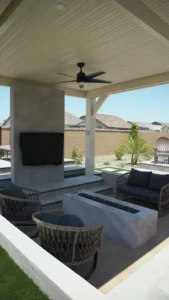
Fire pit installation Phoenix projects for a crowd build a gas or wood-burning feature. Its fuel supply, burner output and seating must all be planned together. A fire that works for four friends often falls short for twenty guests.
Picture a homeowner who hosts groups in the backyard. This host wants everyone gathered around one flame without crowding the patio. Resort-style entertaining in a Phoenix backyard depends on a fire sized for the crowd.
Hosting a crowd takes more planning than hosting a few friends. The rest of the decisions follow in a set order. Decide the fuel type and the longest gas pipe run before choosing a design, because those two facts set the gas line, the permit and the burner size.
Key Takeaways
- Choose the fuel type first, since it sets the gas line, permit and burner size.
- Measure the longest run from the meter to the farthest appliance.
- A gas fire pit lights on demand and goes out at once.
- A wood fire pit needs no gas line but needs smoke and ember planning.
- Match the burner output and seating to the number of guests.
- Confirm the listed clearances before choosing the spot.
Fire Pit Installation Phoenix: Gas or Wood Comes First
For most backyards that host groups in Phoenix, a gas fire pit is the better fit. It lights at the touch of a switch and goes out at once. Guests can enjoy a flame without waiting for kindling to catch.
Natural gas usually arrives through a fixed line from the meter. Propane comes from a tank that must be stored and connected to approved equipment. A gas burner can be switched off at once, while a wood fire keeps burning until the fuel is spent.
Wood gives a classic look and the crackle many guests enjoy. Wood-burning fire pit installation in Phoenix suits hosts who accept smoke and embers in exchange for a traditional fire. A wood-burning pit needs no gas line, but it needs its own smoke and ember planning.
The common mistake is picking wood for a yard where guests will want a fire on short notice. Check the local burn rules before you commit, because they decide when a wood fire can be lit. Wood fire pit installation in Phoenix needs a clear spot away from seating and overhangs.
BTU stands for British thermal unit, the heat a burner is rated to put out per hour. Some hosts want the warmth of a fireplace without walls, and a gas or wood fire pit gives that. An outdoor fire of any kind needs a plan for heat before anything is built.
If the yard has no gas line and the host still wants a flame on short notice, a propane unit on an approved tank is the middle choice.
Gas Line Sizing for a Fire Pit Burner
A fire pit burner is rated in BTU, but the gas pipe is sized by how far the burner sits from the meter. Pipe sizing depends on the longest run from the meter to the farthest appliance. It also depends on the combined BTU demand of every appliance on the same line.
Gas pipe charts list how much heat a pipe can carry over a given length. A chart applies to one gas type, one pipe material, one pressure and set system conditions. Read the row that matches your run and your pipe, not the closest guess.
Reading the pipe sizing chart
A half-inch standard polyethylene line carries about 111,000 BTU at 30 feet. The same pipe carries only about 58,000 BTU at 100 feet. The table shows how run length changes what each pipe size can carry.
| Pipe size | Run from meter | Capacity or need |
|---|---|---|
| 1/2-inch standard polyethylene | 30 feet | about 111,000 BTU |
| 1/2-inch standard polyethylene | 100 feet | about 58,000 BTU |
| 3/4-inch standard polyethylene | 50 feet | about 169,000 BTU |
| 1-inch pipe | 50 feet | needed for a 200,000 BTU burner |
Distance cuts the heat a pipe can carry. A 75,000 BTU fire pit on a 110-foot run falls in the chart row for 125 feet, so it uses 3/4-inch pipe. A small burner on a long run can still need a bigger pipe.
Matching burner demand to the pipe run
Two measurements set the pipe size, and the burner name alone does not. Measure the longest run from the meter to the fire pit. Then add up the BTU rating of every appliance that shares the line. Gas fire pit installation in Phoenix needs the longest run measured before any pipe is ordered.
The common mistake is sizing the pipe to the burner alone. Ignoring a long run leads to a line that cannot feed the flame. Measure the run from the meter to the fire pit before ordering pipe, because the longest run sets the size even when the burner is small.
Gas Line Permit, Code Check and Inspection
A gas fire pit in Phoenix needs a fuel-gas permit and inspection when its gas line is new or extended. A new line runs from the meter to the pit. An extended line adds length to a gas line that already exists.
Gas fire pit installation in Phoenix starts with one question: is the line new or extended? A freestanding wood-burning pit or a portable-bottle propane unit typically needs no building permit. A fixed gas line does not get that exemption.
Each stage of the project has its own check. Follow these steps in order.
- Check the capacity of the existing gas system before adding the pit.
- Pull a fuel-gas permit for a new or extended line.
- Install the line and the fire pit.
- Pressure-test the line.
- Call for inspection before the trench is backfilled.
Phoenix fuel-gas code requires an existing piping system to be checked for capacity when a new appliance connects. If capacity is short, the system must be enlarged or separate adequate piping must be added. The common mistake is covering the trench before the inspector sees it.
Ask who pulls the permit and confirm that the inspection happens before the trench is backfilled.
Burn Restrictions for Wood-Burning Fire Pits in Maricopa County
On a No Burn Day in Maricopa County, a wood-burning fire pit cannot be lit, while a gas fire pit is still allowed because gaseous fuels are exempt. A No Burn Day is a county-declared day when most wood burning is restricted. Each kind of fire falls under a different rule.
| Situation | Arizona open-burn permit | Maricopa County rule |
|---|---|---|
| Cooking, campfires, warmth or recreation | No permit required | Only gaseous fuels or clean dry wood on days without restrictions |
| Weed abatement or fire-hazard prevention | Permit required | No burning of household or yard waste |
| Household waste or yard trimmings | Not a permitted fire | Prohibited in all cases |
Maricopa County’s Fireplace Retrofit Program says gas log sets may be burned on No Burn Days. That point covers gas log sets in fireplaces, so it shows how the county treats gaseous fuels.
Fines add up quickly for improper burning. Maricopa County residential fines for improper burning in fireplaces, chimeneas and woodstoves range from $50 to $250. The county’s minimum fine for an illegal outdoor fire is $200, and higher fines are possible.
The common mistake is burning yard trimmings or household waste in the pit. Tree trimmings count as yard waste, and burning them is prohibited. Lighting a wood fire on a No Burn Day is the other common error, even for a small fire. A campfire-style fire for recreation needs no Arizona open-burn permit.
Burn only clean, dry wood, since burning yard trimmings in the pit can bring the higher fines.
Burner Choices and Seating for a Crowd
A round gas burner ring suits a group seated in a full circle, while a linear pan suits a long bench on one side. The choice follows the seating plan. Sketch the seats before picking the burner.
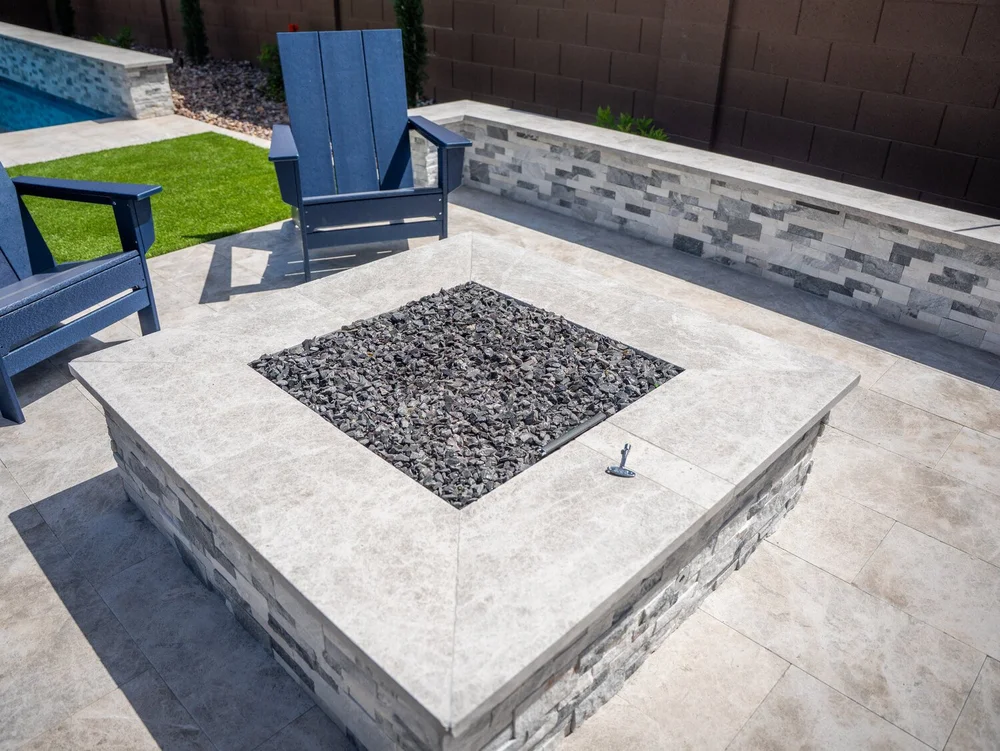
A fire pit has no firebox, so guests can sit on every side and see the flame without obstruction. A fireplace has walls that block the view from many angles. That open design makes a fire pit a strong fire feature for a group.
Burner layouts that suit a group
A round burner ring creates one center flame, and seats can ring it on every side. A linear pan sits under a bench-style row and gives a long, even line of heat. Fire pits suit smaller Phoenix backyards, where a round ring fits the space.
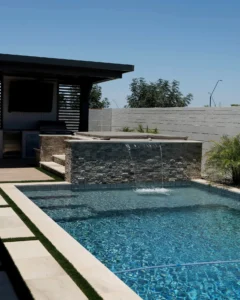
A metal fire ring is one material choice for the pit. Metal fire pit installation in Phoenix needs a ring whose metal and welds suit the burner’s heat output. Some hosts build the pit into a water fountain design for a second focal point.
Seating around the flame
Seating usually sits about 4 to 6 feet from the flame edge. That spacing gives comfortable heat and easy conversation. A stronger burner pushes the seats farther out, while a smaller one lets them sit closer.
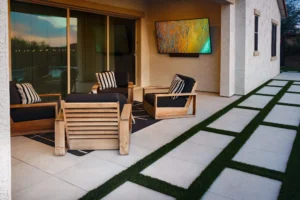
The common mistake is placing seats so close that guests stand up into hot air. Set the fire feature on the patio with room for chairs to move. Leave a clear walking path of about 3 feet between seats so guests can leave without stepping through the heated zone.
Placement, Clearances and Surfaces
Set the fire pit where the wind carries smoke away from the seats and where the flame sits well clear of walls, fences and patio covers. Outdoor fire pit installation in Phoenix places the burner where the flame sits clear of structures and the seats sit outside the heat zone. Check these points before you dig.
- Wind direction across the seating area
- Overhead structures such as pergolas and patio covers
- Fences and walls near the burner
- Surface material under and around the burner
- Pathways and existing landscaping
Surfaces around the burner should be noncombustible, such as pavers, stone or concrete. Pergolas, patio covers and overhanging branches all count toward the clearance. The manufacturer’s listed clearance sets the minimum distance for the installed unit.
The common mistake is assuming a covered patio suits an open flame. A cover can overhang the burner and change the safe spot. Confirm the manufacturer’s listed clearances before choosing the spot, because that listing is the limit the installation must meet.
Conclusion
Settle the fuel type and the longest gas pipe run first, since those two decisions set the gas line, the permit and the burner size. A gas fire pit suits most crowds, but the pipe run decides how much line you need.
Book an on-site visit to measure the meter-to-pit run, count the seats and check the placement. Ask for a written estimate that lists the fire feature, the gas work and the landscaping as separate lines. Bring the planned seat count and the meter location to the visit so the burner and pipe can be sized before the estimate is written.