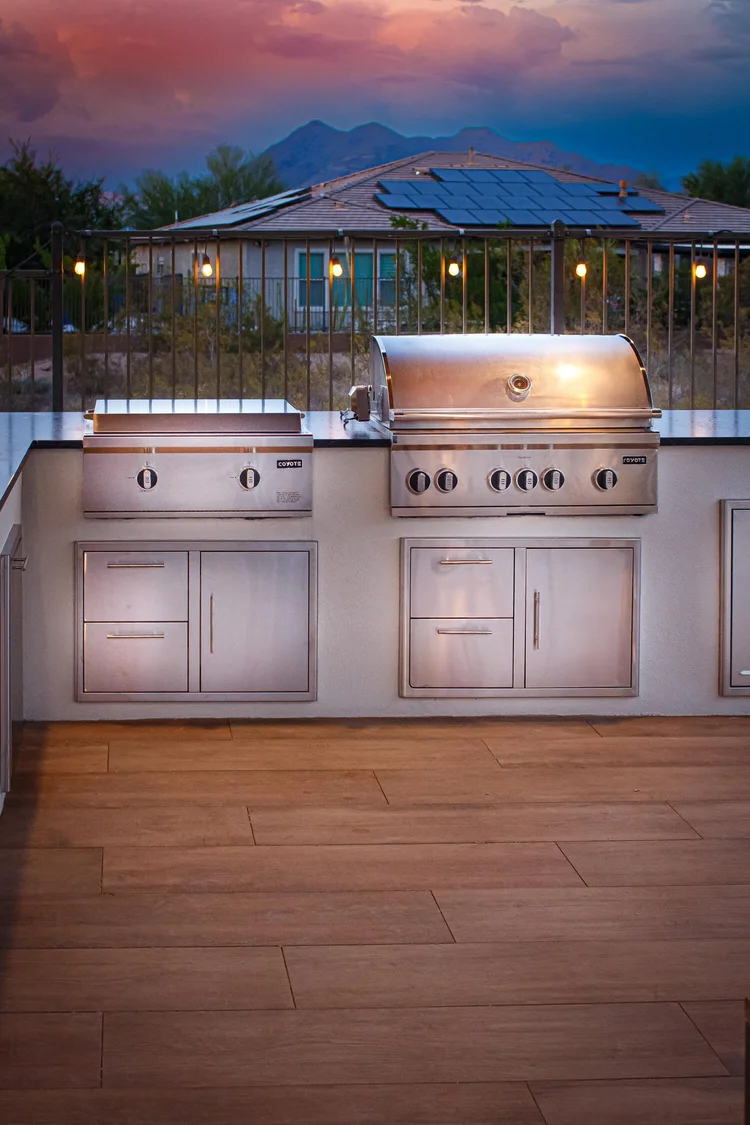
Before you hire an outdoor kitchen contractor, check the Arizona license with the Registrar of Contractors. Then get a written contract and confirm the base and grill specs before you sign.
If your Scottsdale yard is still rock or gravel, you need a rock-free yard with a sound base. The aggregate base is the compacted layer of crushed rock under pavers or patio slabs. It carries the load and lets water drain, so the kitchen stays level.
This guide covers ten questions in six groups: license, deposit and written contract, design details, materials, scope and repairs, and references. Each one helps you spot a weak contractor before money changes hands. A small patio kitchen and a large home improvement need the same written terms.
A common mistake is accepting a verbal quote for a yard that has already been dug out. Once the rock is gone, you have less room to walk away from a bad deal.
Key Takeaways
- Check the Arizona license on the Registrar’s lookup before the first site visit.
- Put the price, payment schedule, scope and warranty in a written contract.
- Confirm the base depth and the grill clearance in the drawings.
- Ask for the test rating of every tile and countertop.
- Visit one finished job before you choose a backyard remodel crew.
Run the license search before the first site visit, not after a deposit check has been written.
Choosing an Outdoor Kitchen Contractor You Can Verify
Search the contractor’s exact company name on the Arizona Registrar of Contractors license lookup before you sign anything. For most Scottsdale homeowners, the best outdoor kitchen contractor is the one whose Arizona license is active, matches the contract name, and has built several outdoor kitchens in Maricopa County. An Arizona contractor license check takes only a few minutes online.
Check four things on the lookup and in the paperwork you receive:
- The company name on the contract matches the license holder’s name.
- The license shows as active on the day you sign.
- The license class covers outdoor kitchen work, including masonry and concrete.
- Proof of liability insurance and workers compensation coverage is available on request.
Watch for a company whose license is held by someone who has since left it. That can leave you with a crew that is not licensed at all. If you plan to do the work yourself on your own home, ask the Registrar whether the license rule applies to you.
Outdoor kitchen contractors near you are easier to reach for warranty visits. Ask where the crew is based and how far it travels to a Scottsdale job. Save the license number and the date of the search with your contract, so the record exists if the work is disputed.
Deposits, Payments and the Written Contract
Arizona sets no general deposit cap for residential remodeling, so the deposit amount comes from what you sign. Arizona does require a written contract for residential work over $1,000. The written contract lists the price, payment schedule, scope and warranty.
Deposit caps for pools, spas and storm repairs
Two cases have caps. For covered in-ground pool or spa contracts, the deposit cap is 15% of the original price at signing. For contracts to repair catastrophic-storm damage paid through insurance, the cap is 50% of the contract price.
An outdoor kitchen usually falls outside the 15% pool and spa cap, because it is not a pool or spa. A smaller job under $1,000 does not need a written contract by law. Ask for a written scope anyway, so your outdoor living plans are on paper.
Payment schedule inside the written contract
A common payment schedule ties each payment to a finished stage, such as footing, masonry, appliance set and final walkthrough. Hold the final payment until the walkthrough is complete and every item on the punch list is fixed.
The common mistake is paying cash or through a payment app with no receipt. Without a record, you cannot prove what you paid or when. Refuse any large deposit that is requested before the license check or before a signed contract exists.
Pay the deposit by check or card to the company named on the contract, never in cash.
Design Details That Decide Whether the Build Works
The manufacturer’s spec sheet sets the built-in grill clearance beside, behind and above the unit, so ask for that sheet before the drawings are final. Good outdoor kitchen ideas place the grill under a ventilation hood with a clear path for the smoke and heat.
Clearance, cabinetry liner and hood sizing
A built-in grill in Werever HDPE cabinetry needs a factory-made insulating liner, also called an insulating jacket. HDPE is a tough plastic that can soften under heat if the liner is missing. Use the table below to check the key numbers before you approve the design.
| Item | Minimum or rule | What to ask for |
|---|---|---|
| Grill clearance | Manufacturer’s spec, plus any local code | Clearance numbers written into the drawings |
| Hood width | At least 6 inches wider than the grill | Hood width listed on the order |
| Hood airflow | At least 1,200 CFM, more for higher BTU output | Fan rating in writing |
| Hood mounting height | 36-42 inches above the cooking surface | Height marked on the plan |
| Cabinet liner | Factory insulating jacket for HDPE cabinetry | Liner listed in the grill order |
A covered outdoor kitchen may need a ventilation hood, and local requirements vary by jurisdiction. CFM means cubic feet per minute, a measure of airflow. The common mistake is setting appliances against a house wall with no hood and no vent path.
Base depth, slope and sand bed under pavers
For outdoor kitchen patios on stable soil, the finished aggregate base is at least 2.5-3 inches deep. The patio should slope 1-2% away from the house. A 1-inch bed of washed concrete sand sits beneath the pavers.
Over expansive clay, uncontrolled fill or unstable subgrade, add 2 inches of aggregate base and install geotextile. Expansive clay swells when wet, and geotextile is a fabric that keeps the soil and the base from mixing. Never skip the geotextile on those soils, because the kitchen can shift as the ground moves.
Ask the contractor to write the grill model and its clearance numbers into the drawings, not only into the proposal.
Outdoor Kitchen Ideas That Survive the Arizona Sun
A 2-centimeter porcelain slab is heat-resistant enough for an outdoor counter, but the floor needs a slip rating before anything else. Good outdoor kitchen ideas use a 2-centimeter porcelain or stone countertop, a porcelain or textured floor tile, and a sealed stone or stucco-finished base. These materials handle Arizona sun and heat well.
Check each number in the table before you choose a tile or a countertop.
| Item | Target | When it matters |
|---|---|---|
| Floor slip rating | Dynamic coefficient of friction of 0.55 or higher (ANSI A326.3) | Wet and greasy areas, such as the grill side |
| Water absorption | 0.5% or less | Makes porcelain tile impervious (ANSI A137.1) |
| Freeze-thaw rating | 15 cycles under ASTM C1026, or 100 cycles under ISO 10545-12 | Only where temperatures drop below freezing |
| Countertop slab | 2-centimeter porcelain | Heat-resistant outdoor countertops |
The common mistake is choosing a glossy floor tile at the grill. Glossy tile looks sharp in the showroom, then turns slick the first time grease or water hits it. A textured surface with a high slip rating keeps you steady.
The freeze-thaw test matters only where temperatures fall below freezing, so a Scottsdale yard usually does not need it. Ask for the test rating of each tile, not only the product name, and check it against the floor where it will be laid.
Scope, Permits and Repairs After Completion
Ask who pours the concrete footer and builds the base, because a weak base is what makes pavers settle later. An outdoor kitchen is extremely heavy, so the footing belongs in the scope of work. Get the footing, base and permits written into the same document.
Who builds the base and whether a permit applies
Ask whether the crew builds the base itself or hands it to a subcontractor. Ask which subcontractors will work on your site and who supervises them. The answer should appear in the written scope.
The base goes down in layers, and each layer must be packed before the next one goes on. Patios and walkways need 4-6 plate-compactor passes per lift. No loose base lift should be thicker than 3 inches.
Not every home-improvement project in Scottsdale needs a permit, so ask which permit applies and who pulls it. The contractor should name the permit in the scope, along with any inspection of the footing and gas or electric lines.
Outdoor kitchen repair and warranty after completion
Most outdoor kitchen repairs start with grout, sealer or the gas and electric connections. Keep the warranty valid with routine care. Keep countertops sealed, clean or replace grout in time, and rinse appliances with a garden hose or a low-pressure wash.
A warranty that excludes the footing or the base is a warning sign. Those parts carry the weight of the whole kitchen, so they should be covered.
Get the warranty term and the list of covered repairs in writing before you make the final payment.
How to Check References and Complaint Records
Ask for three recent outdoor kitchen references and visit at least one finished job before you sign. Ask for projects built in the Phoenix area, since local heat and soil conditions shape the results. Visit a job that is at least a year old, so you can see how the base and surfaces hold up.
Check these four things before you choose:
- Three recent outdoor kitchen references in the Phoenix area
- A visit to one finished job
- Reviews that mention the base, the timeline and change orders
- A written design and fixed-price quote after a site visit
Check the complaint history under the company’s exact name and under the owner’s name. Look for patterns, such as several complaints about unfinished work or missed dates. Use the site consultation to ask whether the design is included in the quote.
Do not rely on a company’s own praise, award claims or client quotes on its website. A newer firm with fewer jobs can still be licensed and insured. In that case, ask for a shorter reference list, but still ask for at least two references.
Ask each reference whether the project finished on the agreed date and whether every change was written down.
Conclusion
Verify the license, put the deposit and payment schedule in writing, and confirm the base and grill specs before any demolition starts. The Arizona license and the written contract come first, before any money moves.
The base and the grill specs decide how the kitchen performs for years, long after the crew leaves. A kitchen on a sound base stays level, and a well-placed hood keeps smoke and heat moving away from you.
Send the same ten questions to every contractor you consider and compare the answers in writing before you choose.